
When should GCSE revision start?
It’s one of those questions I definitely found myself Googling once E got into Year 11.
Should he have started already? Was everyone else doing hours every night? Had we left it too late?
The reality in our house was much less organised than that.
E probably started doing bits of revision around October of Year 11, but I wouldn’t say he was properly revising at that point. I was encouraging him to start making flashcards and revision resources, but there wasn’t a huge amount happening before his first set of mocks in December.
And, if I’m honest, there was quite a lot of nagging.
What I learned over the course of Year 11 is that GCSE revision doesn’t really have one perfect starting date. For us, it gradually ramped up throughout the year, with the first mocks being the point where things suddenly became a lot more real.
So, when should GCSE revision actually start?
If I was doing it again, I’d encourage my youngest to start light revision from the beginning of Year 11, rather than waiting until mocks are looming.
But by light revision, I don’t mean spending three hours every evening hunched over a desk from September.
More things like:
- making flashcards as topics are covered
- organising notes and revision materials
- going back over weaker topics
- getting familiar with exam-style questions
- doing the odd past paper question
- keeping on top of anything they don’t understand
Basically, little and often.
That’s the bit I’d change next time.
Because once you get further into Year 11, there is suddenly an awful lot to revise.
Year 10: does GCSE revision need to start then?
E didn’t do any ongoing GCSE revision during Year 10.
His school had three sets of exams during the year, so he revised for those when they came around, but that was about it.
And I don’t think I’d suddenly have my youngest following a GCSE revision timetable throughout Year 10 either.
What I would encourage more, though, is making revision resources as he goes.
Flashcards, useful notes, formulas, key quotes – all the things you suddenly realise would have been quite handy to have already made when you’re a few weeks away from mocks.
Future me will hopefully remember this.
September and October of Year 11: start getting organised
This is probably when I’d start gently encouraging revision.
E started doing bits around October, although it wasn’t particularly structured.
At this stage, I think getting organised is probably more important than doing hours and hours of revision.
Work out which exam boards they’re doing. Make sure they’ve got the right revision guides. Start making flashcards. Keep school notes somewhere vaguely sensible.
That last one is something we didn’t do particularly well.
By the end of GCSEs, E’s bedroom floor appeared to have become its own revision filing system.
If you’re starting to think about what your teenager might actually need, I’ve put together everything we used in my Best GCSE Revision Resources guide, including what I’d buy again and what we probably didn’t use as much as I’d hoped.
The first mocks were our wake-up call
E’s first proper Year 11 mocks were in December.
Up until then, he’d always been someone who could revise fairly last minute.
For exams in Years 7–10, he’d quite often cram the night before and somehow get through them.
He approached his first GCSE mocks in much the same way.
It didn’t work.
His results weren’t what he’d expected and I think that came as quite a shock to him.
We’d already had a feeling he wasn’t putting enough work in, but rather than constantly battling with him about it, we’d made a conscious decision to let him do it his way and see what happened.
He’s the one sitting the exams, after all.
Those December results probably taught him more than another month of us telling him to revise would have done.
He realised GCSEs were different. There was simply too much content to leave everything until the night before.
After Christmas: revision became more serious
The next set of mocks were in February/March.
This time things were different.
After Christmas we had a proper conversation with E about the amount of work he needed to put in and the fact that he needed to focus if he wanted the results he was capable of.
He took those mocks much more seriously.
This was when revision became more regular rather than something that happened just before an exam.
At weekends, he was probably doing around four hours of revision spread across the two days initially.
Not four hours sitting perfectly at a desk with a timer running.
Just revision happening on and off around normal weekend life.
And yes, we still had to nag.
Easter was when GCSE revision really ramped up
By Easter, the actual GCSE exams were getting close enough that revision felt very real.
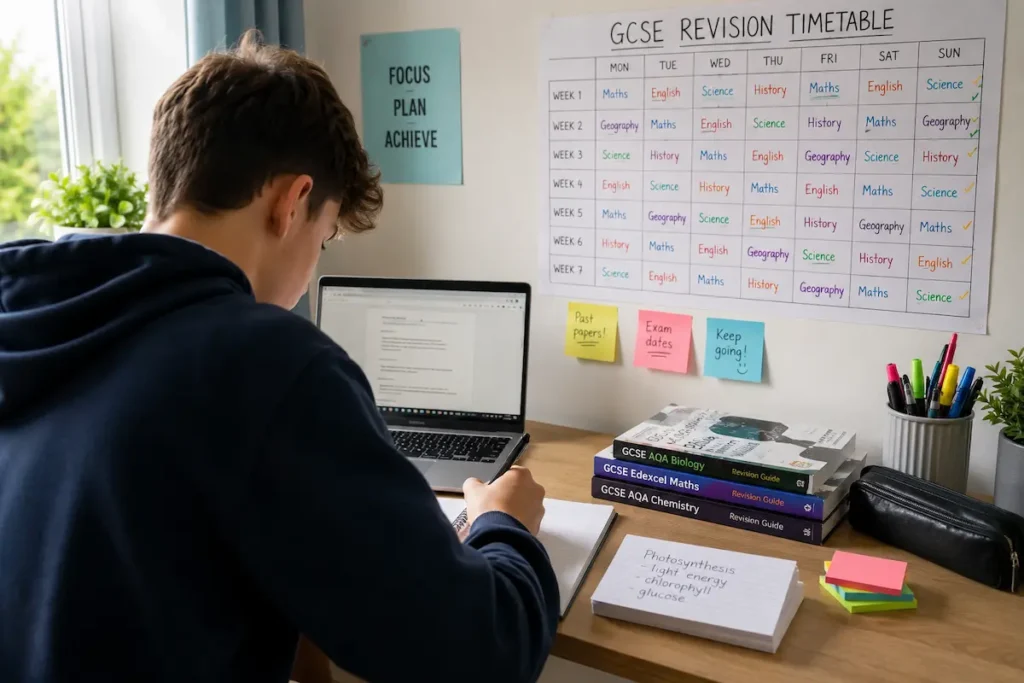
This was when we created a proper revision timetable using ChatGPT.
I’d already used ChatGPT to make timetables for his mocks, so for the real exams I gave it his subjects, exam dates, stronger and weaker subjects and the times he realistically had available.
I also put together a GCSE exam dates guide and printable timetable, which made it much easier to see what was coming up and plan revision around the actual exams.
We also worked around cricket training, late lessons and days when I deliberately didn’t want him revising.
I found that much more useful than expecting him to follow a generic revision planner because it fitted around his actual life.
By this point he was revising most evenings and across the weekends.
How much of the time spent sitting at his computer was actually revision and how much was messing around on his PC?
I couldn’t tell you.
I suspect this is a question quite a few parents of teenagers could ask.
Revision doesn’t have to mean sitting at a desk all weekend
As the exams got closer, revision took up more of E’s weekends.
Early on, it might have been four hours or so spread across Saturday and Sunday. Closer to the GCSEs, he was dipping in and out of revision across most of the weekend.
But we still wanted him to have downtime.
He gamed. He went to cricket. He had breaks.
There were also times when we told him to stop revising.
Or at least stop sitting in front of the computer.
After hours staring at a screen, we weren’t convinced much useful information was going in anymore. Sometimes stepping away was probably more useful than another hour of revision.
Past papers: the thing I kept nagging about
If there was one phrase E probably got sick of hearing during Year 11 it was:
“Why don’t you print a past paper?”
I said it a lot.
Past papers were something I kept encouraging throughout the GCSE process because they helped him get used to the wording and structure of actual exam questions.
Did he do as many as I wanted him to?
Of course not.
But he did use them, particularly as the exams got closer.
You can download past papers and mark schemes free from the exam boards too, so they’re one of the best revision resources that cost absolutely nothing.
Make use of school revision sessions too
One thing I wouldn’t overlook is any extra revision or intervention sessions offered by school.
E’s school started running additional Maths sessions relatively early, and as the GCSEs got closer there were extra sessions for subjects including Science and English too.
I’d encourage your teenager to go to these where they can.
They’re free, they’re being taught by teachers who know the specification and they’re often targeted at the areas pupils need most help with.
Admittedly, persuading a teenager to voluntarily stay at school for more school isn’t always an easy sell.
What if they don’t want to revise?
This was probably one of the hardest bits for us at the beginning.
We knew E wasn’t doing enough.
He thought he could manage it.
There are only so many times you can tell a teenager to revise before everyone gets thoroughly fed up with each other.
We eventually decided we’d given him the advice and resources, so we’d let him approach the December mocks his way.
When the results weren’t what he’d hoped for, he came to the conclusion himself that something needed to change.
After that, we still reminded and nagged – plenty – but as the actual GCSE exams got closer, we needed to do it less.
He became more motivated because he could see what he was working towards.
I’ve shared more of what worked (and what didn’t) for us during Year 11 in my GCSE revision guide for parents.
Don’t forget they’re allowed to get fed up
E absolutely got fed up with revision.
I’d be more surprised if he hadn’t.
Year 11 is a long year and the pressure builds considerably once mocks and then the actual exams begin.
That’s another reason I don’t think starting GCSE revision should mean going from zero to hours every night in September.
There needs to be somewhere to go.
Start small. Build the habit. Increase the amount as mocks and exams get closer.
And let them have a life alongside it.
What I’d do differently next time
With my youngest, I’d encourage him to start a little earlier.
Not necessarily revising more, but preparing earlier.
I’d want him making flashcards and revision resources as he goes, keeping his notes organised and doing little bits of retrieval and exam practice throughout Year 11.
Then when mocks arrive, hopefully he isn’t starting from scratch.
I’d still expect revision to increase after Christmas and become much more focused around Easter.
And I’d still expect to nag.
I’m under no illusions about that bit.
A realistic GCSE revision timeline
If I had to boil our experience down into a rough timeline, I’d say:
Year 10: Keep on top of schoolwork and revise for internal exams. Start saving useful revision resources.
September–October, Year 11: Get organised. Start making flashcards and notes and doing small amounts of revision regularly.
Before the first mocks: Increase revision and start using exam-style questions and past papers.
After Christmas: Make revision more regular and identify the subjects/topics that need more attention.
February/March mocks: Treat these as useful practice for the real thing. Use the results to work out where the gaps are.
Easter: This is when revision really ramped up for us. Have a proper timetable and start working around the actual GCSE exam dates.
Final weeks and during GCSEs: Focus revision around the next exams, keep using past papers and make sure there is still time to eat, sleep and occasionally emerge from the bedroom.
The exact timing will be different for every teenager.
But if there’s one thing I’d take from doing this once already, it’s that starting earlier doesn’t have to mean doing more.
Sometimes it just means doing a little bit now so there’s less panic later.
FAQs about when to start GCSE revision
Is September too early to start GCSE revision?
Not if you keep it manageable. I wouldn’t expect a teenager to be doing hours of revision every night from September, but Year 11 is a good time to start doing little bits regularly. Making flashcards, reviewing topics they’ve struggled with and doing the odd exam question can all make things easier when mocks come around.
Is Year 10 too early to start GCSE revision?
I don’t think pupils need to spend Year 10 following a full GCSE revision timetable. E mainly revised for his school exams at that stage. Looking back, though, I would encourage my youngest to start making flashcards and keeping useful revision notes as topics are covered. It means there’s less to organise once Year 11 gets busy.
Is January too late to start revising for GCSEs?
No. E’s revision became much more regular after the Christmas holidays, following his first set of mocks in December. Starting earlier would have helped, but January still leaves several months before the main GCSE exam period. I’d concentrate on regular revision and identifying weaker topics rather than panicking about what hasn’t been done.
How many hours a day should you revise for GCSEs?
I don’t think there’s one number that works for every teenager. Early on, E might do around four hours spread across a whole weekend. Closer to the exams he revised most evenings and on and off throughout the weekend, but we still made sure he had downtime. For us, building revision up gradually worked better than trying to do hours every day from the start.
More GCSE support for parents