There’s something lovely about having a party in a marquee, isn’t there? Whether it’s a big birthday, a wedding or a family celebration, it can feel really special once the sun starts going down.
But lighting is one of those things you don’t always think about until you actually need it.
Everything looks lovely in the afternoon. The tables are set, the decorations are up and there’s plenty of natural light coming through.
Then suddenly it’s getting dark, people are trying to find the drinks table and you realise you probably should’ve thought about the lighting a bit more.
Or you’ve gone completely the other way and it’s so bright it feels like a school hall!
The good news is, you don’t need to go overboard. A bit of planning beforehand can make all the difference.
Why lighting makes such a difference
It’s not just about making everything look pretty. Although obviously you want that too.
People need to be able to see where they’re going, find the food and drinks and get around without tripping over anything. Especially if you’ve got children running about or older relatives coming along.
Then there’s the atmosphere.
You probably don’t want the same bright lighting for dinner as you do later on when everyone’s chatting, dancing or just enjoying themselves.
So when you’re sorting out the layout, it’s worth having a look at lighting and accessories for tented events at the same time.
Much easier than trying to sort it all out at the last minute.
Start with three types of lighting
You don’t need to know loads about lighting to get it right. It just helps to think about three different types.
Ambient lighting
This is basically the main lighting. The overall glow that makes the tent feel warm and welcoming.
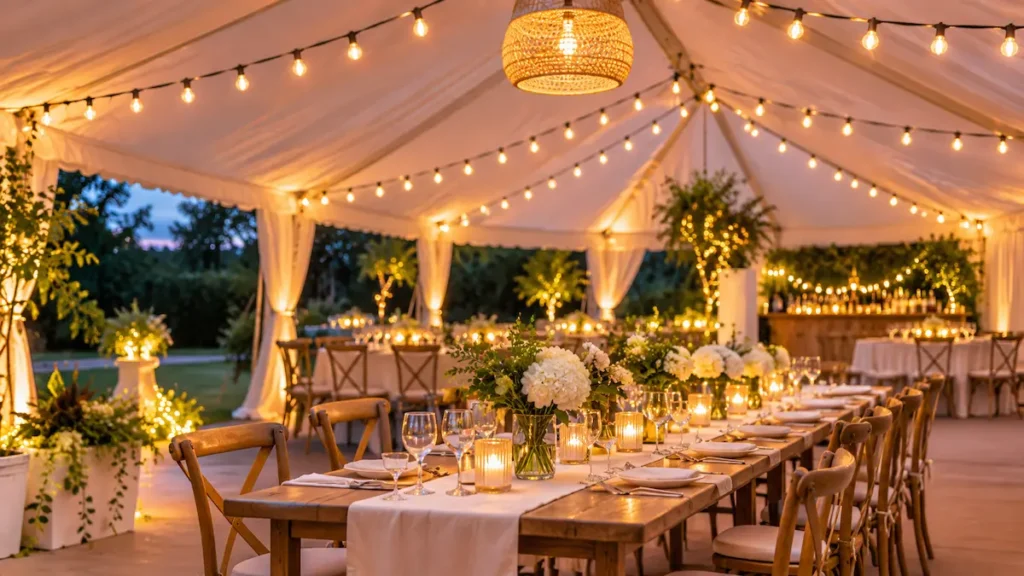
Think strings of festoon lights across the ceiling, hanging lanterns or even chandeliers if you’re going for something a bit fancier.
You want enough light for everyone to see each other properly, but not so much that it feels like you’re sitting under the kitchen lights.
Task lighting
Not the most exciting name, but probably one of the most useful.
This is the lighting you need in places where people actually need to see what they’re doing.
The buffet table, the bar, entrances, toilets. Anywhere people might be reading signs or trying to find something.
Fairy lights look lovely, but they’re not much use when you’re trying to work out what’s on the buffet!
Accent lighting
This is the fun bit.
Accent lighting is just about highlighting certain areas. Maybe the birthday cake, a photo display, a backdrop or the dance floor.
You don’t need loads. Sometimes a couple of well-placed lights are enough to make a space feel that bit more special.
And if you can, go for lights that can be dimmed or controlled separately. That way you can have things brighter while everyone’s eating and turn them down later when the party gets going.
Think about the type of tent you’re using
Not all marquees are the same, so the lighting setup will depend a bit on what you’ve hired.
Frame tents have a structure that can make it easier to spread lighting across the space, as long as the fittings and mounting points are suitable.
Traditional pole tents can look really lovely with strings of lights draped from the centre poles. You know that classic canopy look you see at weddings?
Then there are clear-roof marquees. They’re great during the day because you get all that natural light, and at night you can see the sky. Although you do need to watch out for reflections from the lights.
And of course, it depends on what sort of party you’re having.
For a wedding, you might want soft lighting around the tables and something a bit brighter for the dance floor.
For a big family birthday, you might need more light earlier on while everyone’s eating, especially if there are children around. Then you can make it a bit cosier later.
There’s no one setup that’ll work for every event.
Don’t forget about power and safety
Not the most exciting part of planning a party, I know. But definitely something you don’t want to leave until the day before.
All those lovely lights need electricity.
And if you’ve also got speakers, heaters and catering equipment running, you need to make sure the power supply can cope with everything.
Nobody wants the lights going out halfway through dinner.
A few things to sort out beforehand:
- Where’s the electricity coming from?
- Is there enough power for everything you’re planning to use?
- Where will all the cables go?
- Are the lights suitable for outdoor or damp conditions?
- Will steps, entrances and pathways be properly lit?
- Who’s installing everything and making sure it’s safe?
You really don’t want cables trailing across the floor where people are walking. Especially once it’s dark and everyone’s had a drink or two.
And don’t assume you can hang heavy lights from any part of the marquee. Check with the hire company first.
If possible, get the lighting installed and tested before all the tables and decorations are finished. It’s much easier to move things around when you’re not trying to avoid knocking over someone’s carefully arranged centrepieces.
Common tent lighting mistakes
There are a few things that are easy to get wrong. Particularly if you’ve never organised this sort of event before.
Only thinking about daylight
Everything might look perfect at 4pm. But once the sun goes down, it’s a completely different space.
Relying on fairy lights for everything
They’re lovely for atmosphere, but they probably won’t be enough around the food, entrances or steps.
Hanging lights too low
Nobody wants to spend the evening ducking under decorations. But hang them too high and you might lose some of that lovely cosy feeling.
Making everything too bright
You want people to see what they’re doing, obviously. But harsh lighting can take away from the atmosphere you’re trying to create.
Not testing the lighting beforehand
This is probably the biggest one. If you can, check how everything looks around dusk rather than waiting until the party’s already started.
How it could work for a big family celebration
Say you’re organising a 40th wedding anniversary party for around 120 people.
You’ve hired a big marquee with tables in the middle, a buffet down one side, a bar in the corner and a little dance floor at the back.
Everyone’s arriving at 5pm, so it’ll still be light outside. But by the time you’ve had dinner and the music starts, it’s going to be dark.
You could have strings of warm lights across the ceiling to give the whole marquee a nice glow.
Then some brighter lighting around the buffet and bar, so people can actually see what they’re getting.
A few smaller lights around the anniversary cake and maybe a display of old family photos.
And once dinner’s finished, you could dim the main lights a little.
Nothing particularly complicated.
You’d still need to check everything with the marquee or lighting supplier, of course. Especially the power supply and how the lights are being fitted.
But you get the idea. Different lighting for different parts of the evening.
A few things to check before the big day
Before you tick lighting off your party-planning list, have a quick think about:
- Which areas will people be using after dark?
- Is there enough light around the food, bar and toilets?
- Can you make the lights brighter or dimmer if you need to?
- Has someone checked the power supply?
- Are all the cables safely out of the way?
- Will the lights be installed before the decorations go up?
- Can you have a look at everything around dusk?
If you’re hiring the equipment, let the supplier know how many guests you’re having, what the layout looks like and how long the party will go on for.
They should be able to help you work out what you need.
Getting the atmosphere right
When you think back to a really good party, you probably don’t remember exactly what lights were hanging from the ceiling.
You remember the atmosphere.
Everyone sitting around chatting, the music playing, the warm glow from the lights. And that point in the evening when nobody really wants to go home yet.
That’s the sort of feeling you’re trying to create.
And getting the lighting sorted beforehand means one less thing to worry about on the day.
Which, when you’re organising a big party, is always a bonus.
Frequently asked questions
How much lighting does a tented event need?
It depends on how big the tent is, how many people are coming and what you’re using it for.
Generally, you’ll want some lighting for the whole space, brighter lights where people need to see properly and a few decorative lights for atmosphere.
Your marquee or lighting supplier can help work out how much you’ll need.
When should tent lighting be installed?
Once the tent has been properly secured, but before all the tables and decorations go in.
That gives the team space to put everything up and check it works without having to move everything around afterwards.
What type of lighting works best for a wedding tent?
Warm, adjustable lighting is usually a good choice.
Festoon lights or hanging fixtures can make the tent feel lovely and welcoming, with brighter lighting around the bar, entrances and cake table.
And you might want something separate for the dance floor.
How do I avoid power problems with tent lighting?
Check how much electricity is available before you choose your lights.
Don’t forget about everything else that needs power too. Speakers, heaters, catering equipment and so on.
Your supplier or a qualified electrician should check that the setup is safe and suitable.
Can I use string lights alone in a tent?
You can, but they might not be bright enough for everything.
They’re great for creating atmosphere, but you may need extra lighting around the buffet, entrances and pathways.
Should I test the lighting before the event?
Definitely, if you can.
A marquee can look completely different once it’s dark outside.
Having a look around dusk means you’ve still got time to adjust anything that’s too bright, too dim or shining in the wrong direction.