
When my eldest started properly revising for his GCSEs, I don’t think I really knew what we’d end up needing.
Revision books? Apps? Flashcards? Past papers? A revision planner?
As it turns out, a bit of everything.
We tried quite a few different GCSE revision resources over the course of Year 11. Some we paid for, others were completely free. And some things I bought thinking they’d be used constantly weren’t used anywhere near as much as I’d imagined.
Teenagers.
E definitely preferred revising on his computer rather than sitting with a revision book, although the books still came in useful. We also paid for two online revision platforms, printed what felt like hundreds of past papers and went through a LOT of printer paper.
So if you’re wondering what GCSE revision resources are actually worth buying, these are the things we used and what I’d spend money on again.
One thing I’ve learnt is that you don’t need to have everything bought and ready months in advance. I’ve written separately about when GCSE revision should start, including what we actually did from Year 10 through to the final exams.
If you’re right in the middle of revision season, you might also find my GCSE Revision 2026: Practical Tips for Parents useful. It covers what worked for us, when to start and how we approached revision at home.
My top 5 GCSE revision resources
If I had to narrow everything we used down to five things, I’d probably go with:
- Stationery and flashcards
- Storage for all the revision stuff
- Medly
- An Inspector Calls revision question cards
- CGP revision books
Number two is slightly ironic because we didn’t actually buy any proper revision storage.
Learn from my mistake.
For months there were books, worksheets and bits of paper spread across E’s bedroom floor. I’d definitely sort out somewhere to put everything if we were doing it again.
And we will be doing it again in a few years with my youngest. Lucky me.
Medly
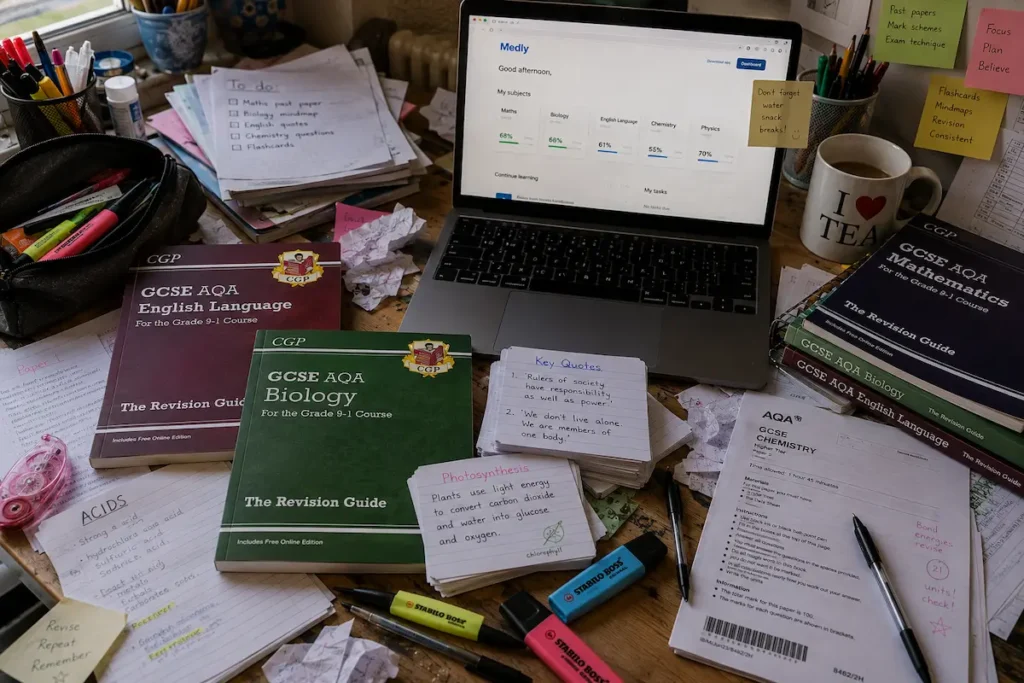
Medly was probably the online revision resource E found most useful in the end.
Interestingly, it wasn’t something I’d found myself. One of his teachers recommended it to us at a parents’ evening.
We didn’t sign up until April, so fairly late in the GCSE revision process. We paid monthly for two months at £24.99 a month rather than committing to a longer subscription.
E used Medly for pretty much all of his subjects apart from Art.
He used it for:
- lessons
- exam-style questions
- past papers
- marking
- identifying weaker areas that needed more work
What he particularly liked was the instant feedback.
By this stage I’d realised that he generally preferred interactive revision on his computer to sitting reading a revision guide, so Medly suited the way he liked to work.
Of all the paid online revision resources we tried, Medly was probably his favourite.
Save My Exams
Save My Exams was actually the first online GCSE revision platform we paid for.
We signed E up after his December mocks and paid upfront for a year.
I found it rather than him asking for it (a recurring theme during GCSE revision…) and encouraged him to give it a try.
When we set his account up, we added all of his subjects and target grades. He then mainly used the revision notes and exam-style questions.
Again, we used it for all of his subjects apart from Art.
He liked Save My Exams and used it throughout the year, although once we discovered Medly he tended to prefer that because of the more immediate feedback.
That doesn’t mean I wouldn’t recommend Save My Exams though.
I’d happily pay for Save My Exams again when my youngest gets to his GCSEs. I think the two platforms just offer slightly different ways of learning and E happened to prefer the more interactive approach of Medly.
Save 10% on Save My Exams: Use code SUBURBANMUM10 at checkout to get 10% off your purchase. The code is limited to 40 uses, so it may not always be available. I’ll earn a small commission if you use my code, at no extra cost to you.
CGP GCSE revision guides and workbooks
We went down the traditional route too.
We bought CGP revision guides and workbooks for pretty much every subject apart from Art and DT.
Did E use them as much as I hoped he would when I bought them?
No.
But he did use them.
He naturally preferred revising on his computer, so the CGP books weren’t usually his first choice at home. They were still useful for quickly looking something up, and he often took them into school on exam days so he could go over things in the morning before an exam.
If your child prefers revising from a physical book rather than a screen, you’ll probably get even more use out of them.
The main thing I’d suggest is checking exactly which exam board and specification your child is doing before ordering revision books. Schools can use different exam boards for different subjects, so don’t assume they’re all the same.
Looking for revision books? I’ve put all the GCSE revision guides, workbooks and revision cards we used together in my GCSE Revision Books We Used Amazon list.
Revision cards and flashcards
Flashcards were one of the simplest things we bought and probably one of the most useful.
You don’t need anything fancy.
We had packs of revision/index cards that E could use for key facts, definitions, formulas and things he needed to remember.
We also bought An Inspector Calls revision question cards, which ended up being one of my favourite purchases from the whole GCSE revision period.
They gave him something quick and focused to work through rather than having to decide what to revise next.
There are similar subject-specific revision cards available for other GCSEs, although I’d only buy them if you think your teen will actually use them. It’s very easy to get carried away buying revision resources in Year 11.
Ask me how I know!
GCSE revision stationery
Stationery was another thing we bought quite a lot of.
Our GCSE revision stash included:
- flashcards/index cards
- highlighters
- black pens
- pencils
- general revision stationery
- clear pencil cases
Looking for revision stationery? I’ve put the stationery and exam-day bits we actually used together in my GCSE Revision Stationery & Exam Essentials Amazon list, if you want to see what we bought.
I actually bought two clear pencil cases.
Not because you need two for GCSEs, obviously. But because I know my child and I could absolutely imagine the only clear pencil case disappearing the night before an exam.
Having a spare meant one less thing to think about.
Before buying lots of stationery, it’s worth checking what your school says pupils need and what is permitted in the exam room.
Buy some storage. Seriously.
This is the GCSE revision resource I wish I’d bought.
Some sort of drawer unit, box, magazine files or folders where all the revision material can live.
We didn’t.
Which meant E’s bedroom floor became the filing system.
There were past papers here. Revision guides there. Random worksheets. Flashcards. School books.
For months.
When we get to GCSEs with my youngest, I’m sorting the storage out before revision starts.
It doesn’t need to be expensive or particularly clever. Just somewhere your teenager can put subject books, printed papers and revision materials without everything ending up in one enormous pile.
You don’t need to buy a GCSE revision planner
There are loads of GCSE revision planners available to buy, but this is one thing we didn’t spend money on.
I used ChatGPT instead. I have the paid version, although you don’t necessarily need a paid account just to try creating a revision timetable.
I gave it E’s:
- GCSE subjects
- exam dates
- stronger and weaker subjects
- available revision hours
- days he had after-school commitments
- cricket training
- late lessons
- weekends where he wasn’t available
I also deliberately blocked out days when I wanted him to have a proper day off. His birthday, for example. Nobody needs to spend their birthday revising GCSE Chemistry.
I then asked ChatGPT to create a revision timetable, broken down by date and into manageable revision blocks.
We actually did this three times.
Once for each set of mocks and then again for the final run-up to the real GCSE exams.
The big advantage was that the timetable fitted around his actual life rather than expecting him to follow a generic revision planner.
It also meant I could tell ChatGPT which subjects needed more attention and adjust things as we went along.
Make an exam timetable too
Alongside the revision timetable, having one simple GCSE exam schedule was really useful.
Schools obviously provide exam timetables, but when your child is sitting exams across several weeks, I found it much easier having our own version showing exactly what was happening and when.
I’ve created a downloadable GCSE exam timetable in my GCSE Exam Dates guide which you can print and use at home.
We had ours somewhere visible so we could all see what exam was coming next.
It sounds like such a small thing, but during the actual exam weeks there is enough going on without someone suddenly asking, “Wait… what exam have I got tomorrow?”
GCSE past papers
Past papers are one of the best GCSE revision resources available.
And they’re generally free.
We downloaded past papers directly from the relevant exam boards and also accessed them through Medly. You can find past papers and mark schemes on the AQA, Pearson Edexcel, OCR and WJEC websites. Just make sure you’re looking at the right specification for your child’s subject.
Then we printed them.
A lot of them.
E used past papers throughout his revision, although — like the CGP books — probably not quite as often as I would have liked.
They became particularly useful for getting used to how questions were worded and seeing the kind of answers examiners were looking for.
We didn’t usually print the mark schemes because that felt like even more paper. He’d bring those up on his computer instead.
If you’re looking for GCSE past papers yourself, make sure you’re downloading papers for the correct exam board and specification.
A printer was unexpectedly useful
I wouldn’t necessarily tell someone they need to rush out and buy a printer specifically because their child is doing GCSEs.
But if you don’t already have one, it’s worth thinking about how you’re going to print revision materials and past papers.
We have an Epson EcoTank ET-2860 and it got a serious workout during Year 11.
We printed so many past papers.
The EcoTank was useful because of the amount we were printing, although we did get through plenty of printer paper.
Being able to say, “I’ll just print that paper for you” rather than relying on school printing things made life much easier.
Gizmo and AI revision tools
E also used Gizmo.
He used the free version for flashcards and quizzes, although I’m not going to pretend I know exactly how regularly he used it because quite a lot of revision happened behind a closed bedroom door.
He also experimented with various AI tools and bots online when he wanted help with something.
This was one of the biggest differences I noticed between how I would have revised and how he did it.
Books were still useful, but he was much more comfortable jumping between online revision platforms, AI, quizzes, past papers and videos.
I think that’s worth remembering before spending hundreds of pounds on physical revision resources.
What about a GCSE tutor?
We also talked about getting E a tutor.
We were more than happy to pay for one if he felt it would help, particularly for any subjects he was struggling with. Quite a few of his friends had tutors during Year 11 too.
But E was adamant he didn’t want one. He felt he could manage the revision himself and, in the end, we followed his lead.
I think this is another one of those things that really depends on the teenager. A tutor can obviously be really useful if your child needs some extra help or is struggling with a particular subject, but I don’t think it’s something you automatically need just because they’re doing their GCSEs.
For us, paying for the online revision platforms and making use of the extra revision sessions at school worked better because that’s what he was actually willing to use.
Free GCSE revision resources are genuinely useful
You really don’t have to spend a fortune.
Alongside everything we paid for, there are lots of useful free resources available.
Past papers from the exam boards are free. Mark schemes are free. There are free online revision resources such as BBC Bitesize, as well as videos, and your child’s school will probably provide resources too.
It’s also worth encouraging them to go to any extra revision sessions their school offers. E’s school ran extra Maths sessions, and as the exams got closer there were sessions for other subjects including Science and English too.
Obviously, getting a teenager to voluntarily stay at school for more lessons isn’t always the easiest sell. But they’re free, they’re usually focused on the areas pupils need most help with and the teachers know exactly which specification they’re working towards.
Even with Save My Exams, Medly, CGP books and everything else we bought, E still used plenty of free resources alongside them.
I’d look at paid resources as something that makes revision easier or more organised, rather than something your child has to have in order to do well.
What would I buy again?
Pretty much all of it, actually.
There isn’t anything we bought that I feel was a complete waste of money.
Some things were definitely used more than others. The CGP books weren’t used nearly as much as I’d envisaged, for example, but they still came in handy. Particularly on exam mornings.
The bigger lesson for me was that the best revision resource is the one your teenager will actually use.
For E, that tended to mean computer-based revision and instant feedback.
Another child might much prefer a pile of CGP books, handwritten flashcards and a whiteboard.
When we get to this stage again with my youngest, I’ll definitely use what we learned the first time around. I’d pay for an online revision platform again, buy the CGP books, stock up on flashcards and stationery and print plenty of past papers.
But first?
I’m buying the storage.
FAQs about GCSE revision resources
What are the best GCSE revision resources?
There isn’t one resource that will suit every teenager. E preferred online revision and instant feedback, particularly Medly, while CGP books, flashcards and past papers were useful alongside it. I’d try a mixture before spending lots of money on one type of revision resource.
Are GCSE revision guides worth buying?
I think so, but it depends on how your child likes to revise. We bought CGP revision guides and workbooks and they were useful, although E didn’t use them as much as I’d originally expected because he preferred revising on his computer.
Do you need to pay for GCSE revision resources?
No. There are plenty of useful free GCSE revision resources, including exam-board past papers and mark schemes, BBC Bitesize and resources provided by schools. We paid for online platforms and bought revision books and stationery because they made revision easier, but you absolutely don’t need to spend a fortune.
More GCSE support for parents