
These days, choosing a dentist often starts with an online search rather than a phone call. Patients compare practices, read reviews, browse treatment pages and decide whether to make an enquiry or book an appointment, often within minutes. Your website may be the first impression they have of your practice, so it needs to make that first impression count.
A good dental website does more than look professional. It needs to help people find what they’re looking for, feel confident about the practice and make it easy to take the next step. Whether that’s booking with a family dentist, looking into orthodontic treatment or finding out more about cosmetic dentistry, nobody wants to spend ages hunting around a website trying to work out what to do next.
Why dental website design matters
Your website is one of the most useful marketing tools your practice has. It’s there 24/7, answering questions and helping potential patients work out whether your practice might be right for them.
Working with a professional dental marketing agency can help practices create a website that reflects their services and brand, while also thinking about what patients actually need from it.
Good dental website design doesn’t need to be complicated. Visitors should quickly be able to see what treatments you offer, where you’re based and how to contact you or book an appointment. They really shouldn’t have to hunt through several pages to find a phone number.
Trust matters too. Clear treatment information, details about the dental team, genuine photography and simple navigation can all help someone feel more comfortable about getting in touch.
And then there’s actually being found in the first place. Even the nicest-looking website isn’t much use if nobody can find it. A good dental SEO strategy can help search engines understand what your practice offers and give you a better chance of appearing when people search for dentists or treatments in their area.
Start with a responsive, mobile-friendly website
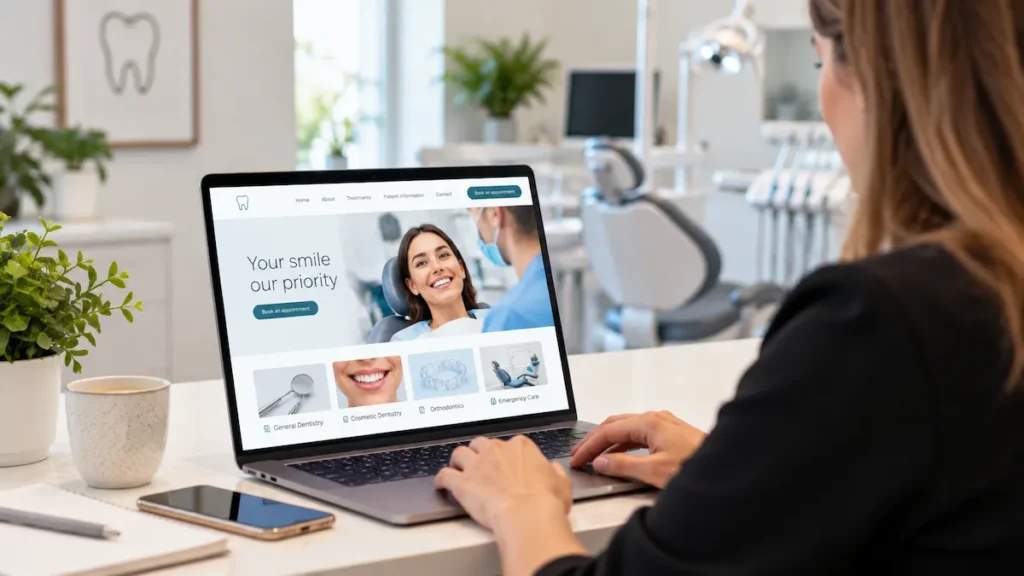
Most of us reach for our phones when we need to look something up, and finding a dentist is no different. Someone might be searching for an emergency dentist, checking opening hours or comparing a couple of local practices. If the website is a pain to use on a phone, it’s very easy to give up and try somewhere else.
A responsive website automatically adjusts to different screen sizes, keeping text readable, images properly displayed and buttons easy to tap.
Speed matters too. Large images, unnecessary scripts and other elements can slow a website down, particularly on a mobile connection. Keeping pages fast and straightforward makes for a much better experience.
Accessibility should also be considered from the beginning. Readable fonts, good colour contrast, descriptive alt text for useful images and keyboard-friendly navigation can make a website easier to use for more people.
Build trust through clear, professional design
People are forming an impression of a practice before they’ve even met the team, so the website needs to feel professional and reassuring without throwing too much information at them at once.
Clean layouts, consistent branding and good-quality photography can all help. Avoid cluttering pages with unnecessary animations, pop-ups or graphics that make it harder for visitors to find what they came for.
Reviews and patient feedback can also help visitors understand other people’s experiences of the practice. However, dental practices need to be careful that all website advertising and promotional information is accurate, current and not misleading. Claims about treatments, qualifications or expected results should be factual and capable of being supported. GDC UK
Before-and-after images may be useful when explaining treatments such as orthodontics or cosmetic dentistry, but practices should make sure they have the appropriate permission to use patient images and avoid presenting individual results in a way that could create unrealistic expectations.
Branding should remain consistent throughout the site too. Colours, fonts, tone of voice and photography should feel as though they belong to the same practice rather than changing noticeably from page to page.
Make it easy for patients to take action
It sounds obvious, but websites can lose potential enquiries simply because visitors can’t work out what they’re supposed to do next.
Important pages should have a clear next step, whether that’s booking an appointment, calling the practice or sending an enquiry.
Contact details should also be easy to find. A useful contact page might include clickable telephone numbers, opening hours, an enquiry form, the practice address and directions.
Online booking can make things even easier, particularly for patients who are browsing outside normal opening hours. If online booking isn’t available, a simple enquiry process is still preferable to a long form asking for information the practice doesn’t yet need.
Small things can make a difference here. Clear buttons, shorter forms and plain language all make it easier for someone to go from reading about a treatment to actually contacting the practice.
Create useful, search-friendly content
Design alone won’t help people find your practice. The content on the site matters just as much.
Giving individual treatments their own useful pages allows you to explain what they involve while also helping search engines understand the services your practice provides.
Rather than filling those pages with variations of the same search keywords, concentrate on the questions patients actually have. What does the treatment involve? Who might it be suitable for? How many appointments could be needed? What should someone expect afterwards?
Any information about treatment should be balanced and easy for patients to understand. Current GDC advertising guidance says dental advertising should be accurate and not misleading, with claims backed by facts and information presented in a way that enables patients to make informed choices.
Local search matters too. Keeping your Google Business Profile accurate, including opening hours and contact details, can complement the information on your website and make it easier for people searching locally to find the practice.
Improve the user experience
User experience sounds like marketing jargon, but really it’s just about making things simple.
Visitors should always have a reasonable idea of where they are on the website and where to go next. A clear menu, descriptive page titles and sensible internal links can make a big difference.
Your homepage should introduce the practice, highlight the treatments or information patients are most likely to need and provide obvious routes to important pages.
Dedicated pages for services such as dental implants, teeth whitening or emergency appointments can also be useful, particularly when someone arrives from a search engine looking for information about one specific treatment.
It’s also worth looking at your website analytics to see what people actually do once they land on those pages. If lots of visitors reach an important treatment page but very few continue to the contact or booking page, for example, it might be a sign that the next step isn’t clear enough.
When should you consider a dental website redesign?
Even a website that worked well when it launched may eventually need updating.
Older sites can suffer from dated layouts, slow loading times, poor mobile performance or information that no longer accurately reflects the treatments and team at the practice.
A redesign is also an opportunity to look at the website from a patient’s perspective rather than simply changing how it looks. Can someone quickly find the treatment they need? Is important information up to date? Does the site work properly on a phone? Is it obvious how to get in touch?
For some practices, an existing website can be improved without starting again. Others may benefit from a more substantial redesign, particularly if the underlying technology is making updates, accessibility or future development difficult.
Don’t forget compliance and security
A dental practice website needs ongoing attention after launch. Content should be kept current, software maintained and appropriate security measures put in place.
There are also specific professional requirements to consider. The GDC requires practice websites to display certain information, including the practice address and contact details, relevant professional qualifications and GDC registration details. Practice websites also need information about complaints procedures, and the GDC says website information should be regularly updated.
Data protection deserves particular attention too. Contact and booking forms should collect only the information that’s genuinely needed and practices need to consider how that information is stored and processed. If a form collects information about a patient’s health, that can be special category data under UK GDPR and is subject to additional requirements and protections.
Regularly reviewing treatment pages, team profiles, contact information and website performance helps keep the site useful for patients as well as supporting its visibility in search.
How can the right dental website design help your practice attract more patients?
Ultimately, a good dental website should make life easier for the people using it. They should be able to find out about the practice, get answers to their questions and know exactly what to do if they want to book an appointment.
Whether you’re planning a new website or improving an existing one, the focus should be on the patient rather than trying to squeeze every possible dental keyword onto the page. Clear navigation, genuinely useful content, good mobile performance and thoughtful design are much more valuable than copy that has obviously been written for a search engine.
If your current website isn’t bringing in the enquiries you’d expect, that doesn’t necessarily mean you need to rip everything up and start again. Sometimes fairly small changes – clearer treatment pages, simpler navigation, faster loading times or an easier booking process – can make a surprisingly big difference.