

Learning to read starts with hearing the different sounds in words. Before children can confidently read and spell, they need to realise that one word can actually be made up of several smaller sounds.
Take a simple word like cat. We hear it as one word. But when children start learning phonics, they’re taught to listen for the three separate sounds: c-a-t.
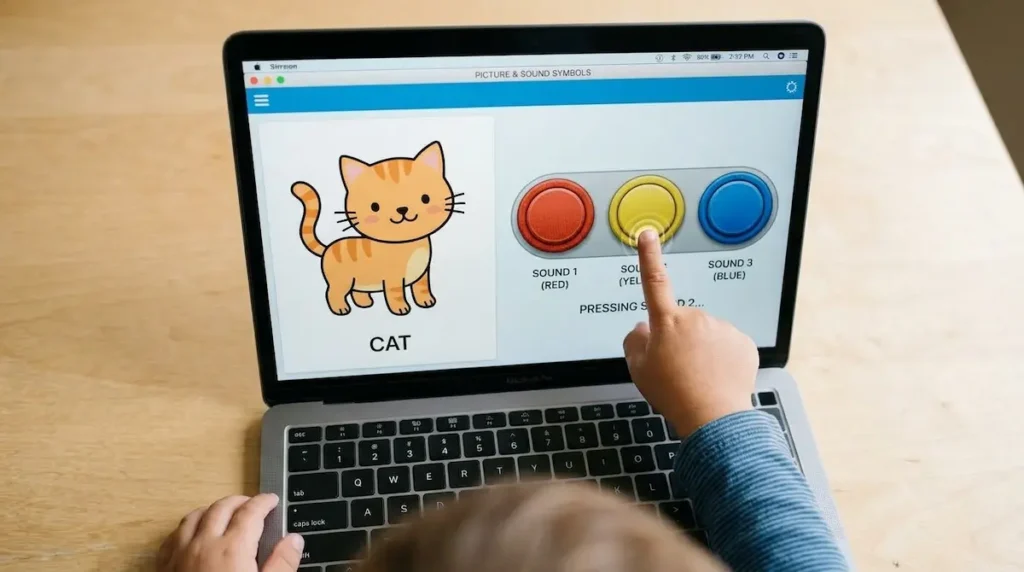
Sound buttons are one way to make this a bit more hands-on. Children can point, tap or press something for each sound they hear. So rather than just listening, they’re doing something at the same time.
And it doesn’t need to turn into a big phonics lesson at home either. A few words and five minutes of practice is plenty.
Why is segmenting words into sounds important?
Before a child can work out how to spell a word like cat, they need to be able to hear the individual sounds in it.
Breaking a spoken word into its separate sounds is called segmenting. It’s an important part of phonemic awareness and something children practise alongside blending sounds when they’re learning to read and write.
The National Institute for Literacy includes phonemic awareness as one of the key areas of early reading instruction, including teaching children how to blend and segment sounds in words.
It can all be a bit confusing at first. Especially because we’re talking about sounds rather than individual letters. A word doesn’t always have the same number of sounds as letters.
Take ship, for example. Four letters, but three sounds: sh-i-p.
How kids can use sound buttons to practise segmenting words into sounds
In phonics, sound buttons are usually dots, lines or other marks underneath a written word. Children point to or tap each one as they say the sounds.
But you can use the same basic idea with counters, buttons or an interactive soundboard. It’s really about giving each sound its own action.
There’s also a free interactive soundboard platform called Soundboardbuttons.com, with lots of different buttons to explore. If your child likes interactive activities, you could use it as another way of making listening and sound practice a bit more fun.
I wouldn’t use it instead of whatever phonics method they’re already using at school though. More as an extra activity to mix things up a little.
So, take the word cat.
Say it out loud and ask your child how many sounds they can hear.
They might tap or press once for c, once for a and once for t.
The button itself isn’t really the important bit. It’s getting them to slow the word down and hear those individual sounds.
Why use something children can tap or move?
If you’ve ever tried getting a young child to sit down with a worksheet when they’re really not in the mood, you’ll know how quickly five minutes can feel like about three hours!
Giving them something to tap, point at or move can make phonics practice feel more like an activity. And a bit less like extra schoolwork.
It also gives them a way of keeping track of the sounds they’ve heard.
Instead of having to hear the word, remember the sounds and write everything down at the same time, they can just concentrate on listening.
Which is plenty when they’re first learning.
And if you’re doing this at home, you really don’t need to recreate a full phonics lesson around the kitchen table. You’re just helping them practise something they’re already learning.
How to set up a sound button activity at home
You don’t need loads of equipment for this. Just start with a few easy words and build from there.
Step 1: Choose some easy words
Start with simple three-sound words such as sun, map, big or top.
These are CVC words – consonant, vowel, consonant. They’re a good place to start because the individual sounds are fairly easy to pick out.
Step 2: Say the word aloud
Say the whole word normally first and ask your child to repeat it.
Then slow it down together.
For sun, you’re listening for s-u-n.
Step 3: Tap once for each sound
Ask your child to tap, point, move a counter or press a button for each sound.
If they don’t get it straight away, don’t worry. Do it together first and then let them have another go.
Step 4: Blend it back together
Once you’ve pulled the word apart, put it back together again.
Say the individual sounds and then blend them into the whole word.
So s-u-n becomes sun again.
Step 5: Try some trickier words
Once three-sound words are getting easier, you can introduce words with more sounds, such as frog, slip or clap.
But there’s no rush.
If three-sound words are still tricky, stick with those for a bit longer.

Using sound buttons in the classroom
Sound buttons can work in the classroom too. Either the traditional dots and lines, counters or something more interactive.
Whole-class segmenting games
The teacher says a word and everyone taps once for each sound they hear.
Doing it together can take some of the pressure off too. Especially for children who might not be confident putting their hand up and answering on their own.
Small-group activities
This can work really well in smaller groups too.
Children could work through a few words together, taking turns to segment them and work out how many sounds they can hear.
And with fewer children, it’s easier for an adult to spot where someone might be getting stuck.
Individual practice
One-to-one practice can also help show which sounds a child is confident with and which ones they find harder.
I wouldn’t worry about how quickly they’re tapping or pressing the buttons.
It’s much more useful to listen to which sounds they’re actually hearing.
If they’re struggling, go back to easier words for a while. There’s no need to race ahead.
Tips for making sound button practice easier
- Keep it short. You really don’t need half an hour. Five or ten minutes is plenty.
- Make it playful. Buttons, counters, Lego bricks, fingers – whatever works. It doesn’t need to look like schoolwork.
- Don’t worry about scores. Personally, I wouldn’t turn it into a race. Hearing the sounds properly is much more important than doing it quickly.
- Mix easy and harder words. Start with a few you know they can do. Then add something a little trickier.
- Follow what they’re doing at school. If their school uses particular words or a specific phonics programme, try to use the same approach at home. It saves confusing everyone!
- Know when to stop. If they’re getting frustrated or have completely lost interest, call it a day. Five useful minutes is definitely better than twenty minutes of everyone getting fed up.
Making phonics practice feel manageable
Segmenting seems pretty obvious to us as adults. But when a child is first learning to read and spell, there’s actually quite a lot going on.
They’re listening to a word, pulling it apart into individual sounds and then eventually working out which letters represent those sounds.
That’s a lot when you’re five or six.
Giving each sound an action – tapping a dot, moving a counter or pressing a button – is just one way of making it a little easier to understand.
And you don’t need loads of equipment or long practice sessions.
Start with easy words. Do a few together. Then stop.
Little and often is much easier to fit into family life. And definitely preferable to turning the kitchen table into an extra classroom.