

CCTV in schools isn’t exactly new. Most of us are used to seeing cameras around school entrances, corridors and car parks, and probably don’t give them much thought.
What’s changing, though, is the technology sitting behind those cameras.
Artificial intelligence (AI) is increasingly being built into security systems. It can help staff search through large amounts of footage much more quickly and, in some cases, alert them to certain types of activity.
As a parent, this is where I start to have questions. What can these systems actually do? Who gets to see footage of our children? How long is it kept? And at what point does school security start to feel a bit too much like surveillance?
As with most things involving AI, I can see the potential benefits. But I also think there are some pretty important questions around privacy and how it’s being used.
Why do schools use CCTV?
CCTV can be one part of a school’s wider security setup.
The Department for Education (DfE) lists CCTV and access-control systems among the measures schools and colleges in England can consider to help protect their premises. That doesn’t mean every school needs the same level of security, though. The guidance says measures should be proportionate to the risks each school actually faces.
Cameras might help staff work out what happened after an incident, investigate vandalism or keep an eye on entrances and other areas where security is particularly important.
But CCTV obviously isn’t a replacement for staff, safeguarding procedures or good security policies. It’s just one part of the bigger picture.
So where does AI come into it?
Traditional CCTV is basically a recording system. Something happens, someone reports it and staff can look back through the footage to work out what happened.
The problem is, that could mean sitting through an awful lot of video.
This is where AI can potentially help. Depending on the system, it might be able to pick out people or vehicles, highlight certain types of activity or simply help a member of staff narrow down their search.
Say, for example, a pupil reports that their bike disappeared from the school bike racks sometime during lunch.
Rather than somebody manually watching a couple of hours of footage from several cameras, searchable video could help them get to the relevant bit much more quickly.
That doesn’t mean AI is deciding who stole the bike. It’s simply helping someone find the footage they need.
And I think that’s quite an important distinction.
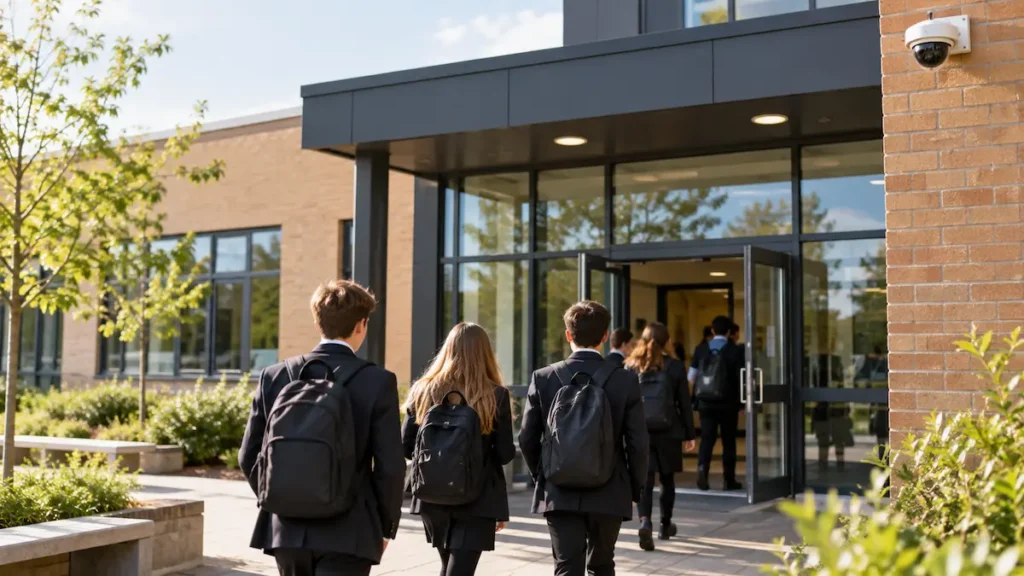
AI could help staff spot incidents sooner
Some newer systems can also analyse live video and flag certain types of activity.
In theory, that means something could be brought to a member of staff’s attention without somebody having to sit watching a wall of CCTV screens all day.
A system might, for example, flag movement somewhere that’s normally empty at that time of day.
But an alert doesn’t automatically mean something is wrong.
Two teenagers messing around could look very different to a computer that has no idea what’s actually going on. Equally, someone might be somewhere unusual because a teacher has asked them to be there.
Which is why the human part still matters.
AI shouldn’t be making the final decision
However clever this technology gets, schools are complicated places. There will always be context that a computer doesn’t understand.
A teacher might know why a pupil is waiting somewhere. Staff might know that a visitor has permission to be on site. Something that looks unusual to software could be completely ordinary once an actual person knows what’s going on.
For me, this is where AI makes the most sense – as something that helps staff find and review information, rather than something making decisions about pupils on its own.
Schools still need people. They still need safeguarding procedures, controlled access, staff training, emergency plans and clear processes for dealing with incidents. Technology can support all of that, but it can’t replace it.
What happens to CCTV footage of your child?
This is probably the bit I’d be most interested in as a parent – what actually happens to footage of our children?
If your child can be identified in CCTV footage, their image counts as personal data. That means schools have responsibilities around how the footage is collected, stored, accessed and shared.
And as the technology gets more sophisticated, where all that footage is stored becomes important too.
Some modern systems use cloud or hybrid storage rather than relying solely on a recorder sitting somewhere within the school. For example, Coram explains how cloud storage for surveillance video can allow authorised users to access stored footage centrally and provide different options for how long recordings are retained.
But convenience obviously can’t be the only consideration for schools.
They also need to think about who can access the footage, how securely it’s stored, how long it’s kept and whether the system is collecting more personal information than it actually needs.
What about facial recognition in schools?
This is probably the bit that would make most parents sit up and take notice.
It’s important, though, not to assume that AI-powered CCTV automatically means facial recognition. They’re not the same thing.
Facial recognition is different because it involves biometric information, which brings a whole other set of privacy concerns.
Current DfE guidance for schools is particularly cautious about it. Schools are advised to avoid CCTV using live facial-recognition technology because it involves sensitive biometric data and poses a high risk to the rights and freedoms of pupils, staff and visitors.
If a CCTV system includes that functionality, the guidance says it should be switched off by default so that the biometric data isn’t processed.
So if you hear that your child’s school is using “AI cameras”, it doesn’t automatically mean pupils’ faces are being scanned and recognised. I’d want to know exactly what the technology does before worrying about what the term AI might imply.
Schools should be transparent about CCTV
Parents shouldn’t have to guess what cameras at their child’s school are being used for.
DfE guidance says identifiable CCTV images are personal data, so schools have to handle them in line with data-protection law. Schools should also be clear about how those images are being used and stored.
If a school introduces more advanced CCTV or AI-enabled security technology, reasonable questions for parents to ask include:
- What is the system being used for?
- Where are cameras located?
- Does the system use AI or automated video analysis?
- Does it use facial recognition or any other biometric technology?
- Who can access the footage?
- Where is footage stored?
- How long is it retained?
- Can footage be shared with third parties?
- What happens when the AI flags something?
- Does a member of staff review alerts before any action is taken?
The answers may already be available in the school’s CCTV, privacy or data-protection information.
Can AI make schools safer?
I think the answer is potentially, yes – but that doesn’t mean more technology automatically equals better security.
Being able to find footage quickly could make it much easier to investigate an incident. Alerts could also draw someone’s attention to something that might otherwise be missed.
But schools still need to ask what problem they’re actually trying to solve. Is this particular technology necessary? Will it genuinely help? And is that benefit proportionate to the impact it could have on pupils’ privacy?
That’s probably the way I’d look at it as a parent too.
Rather than simply asking “Does my child’s school use AI?”, I’d want to know:
“What does it actually do, why are they using it and what safeguards are in place?”
FAQs
Is CCTV allowed in schools?
Schools can use CCTV, but footage in which people can be identified is personal data and must be handled in accordance with data-protection law. Schools need to consider why CCTV is necessary and how images are collected, stored, accessed and shared.
Can schools use AI with CCTV?
AI technology can be incorporated into video-security systems for functions such as searching footage or generating alerts. Schools still need to consider data protection, necessity, proportionality and the particular technology involved.
Does AI CCTV mean facial recognition?
No. AI-assisted video technology can include many different functions, and facial recognition is only one possible technology. Current DfE guidance advises schools to avoid CCTV with live facial recognition because of the risks associated with processing sensitive biometric data.
Can school CCTV record conversations?
DfE guidance says schools should not use CCTV to record conversations, describing this as highly intrusive and unlikely to be justifiable.
Can I ask my child’s school how its CCTV is used?
Yes. A school’s privacy and CCTV information may already explain how its system is used. If you’re concerned about newer AI functionality, you can ask the school what technology is operating and how pupils’ data is protected.
The bigger picture
AI is becoming part of all sorts of everyday technology, so it’s probably inevitable that we’ll see more of it in schools too.
Used sensibly, it could be genuinely useful. If it helps staff find the right bit of CCTV quickly or alerts them to something they need to look at, I can see the benefit.
But I wouldn’t want technology replacing the people, safeguarding procedures and judgement that actually keep children safe.
And as a parent, I think we should be told how it’s being used.
We don’t need to understand every technical detail of the camera hanging above the school entrance. I certainly don’t. But we should be able to find out what it’s doing, what happens to footage of our children and what safeguards are in place.
For me, that’s the important bit as this technology becomes more common.
This article provides general information about school security and data protection and is not legal advice. Requirements can vary according to the type and location of the education setting.
Sources