
Think back to your own school days.
Chances are, you probably remember a school trip or two more clearly than most of your lessons.
Maybe it was a visit to a museum, a day at the seaside or a residential trip where something didn’t quite go to plan.
Those are the things that tend to stick, aren’t they?
And while school trips might sometimes feel like a nice break from the usual routine, there’s actually a lot more to them than just getting out of the classroom for the day.
Children can learn all sorts of things when they’re somewhere new. Sometimes without even realising they’re learning.
So are school trips really that important? Let’s look at a few of the common assumptions.
Myth: trips are just a day off from proper learning
It’s easy to think of school trips as a bit of a treat.
A day away from lessons, a packed lunch and the excitement of getting on a coach with their friends.
But just because children aren’t sitting at a desk doesn’t mean they’re not learning.
A visit to a farm, for example, gives them the chance to see things they’ve been learning about in Science.
A trip to a historical site can help bring something they’ve read about in History to life.
And museums and galleries give children the opportunity to ask questions, explore and discover things for themselves.
Rather than just reading about something in a textbook, they’re seeing it for real.
And sometimes that’s what helps everything click into place.
Myth: the destination is what matters most
You might assume that the bigger or more exciting the destination, the more children will get out of it.
But that’s not necessarily the case.
A trip to a famous castle or museum can be brilliant, of course.
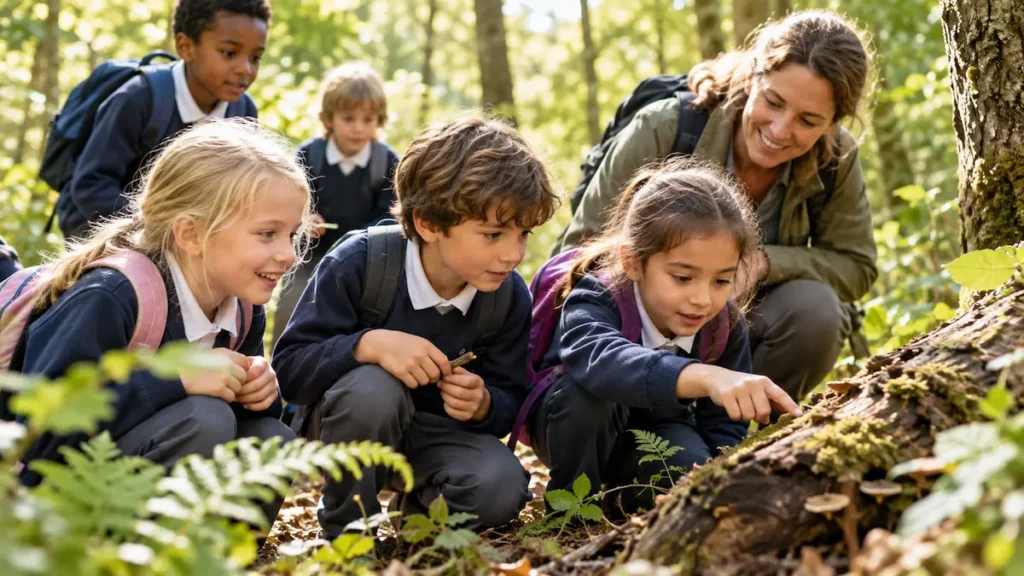
But even something as simple as a walk through a local woodland can turn into a really interesting learning experience.
Children might spot different insects, notice how the trees change with the seasons or start asking questions about the wildlife around them.
And you don’t have to travel far to find places worth exploring either. There are plenty of lovely places to visit locally, as you’ll see in my Surrey Days Out guide, with ideas for family outings that can be fun and educational too.
Sometimes those little discoveries can spark an interest in something they’d never really thought about before.
It’s less about how far they travel and more about what they get to experience while they’re there.
Schools that put thought into their trips can help children make those connections between what they’re learning in class and the world around them.
That’s something worth considering when looking at a prep school that treats the wider world as part of the curriculum.
Because learning doesn’t have to stop at the classroom door.
Myth: children forget it all by the next week
We’ve all had those conversations after school.
You ask what they’ve done that day and get a very enthusiastic “nothing” in return.
But ask about a school trip and suddenly there’s a whole story to tell.
Where they went, what they saw, who they sat next to on the coach and what happened at lunchtime.
And while some of those details might seem fairly unimportant, the experience itself can help children remember what they’ve learnt.
Seeing something up close, hearing the sounds or being able to touch and explore something can make it much more memorable than simply reading about it.
They might even make a connection weeks later when something comes up in a lesson.
Suddenly, it’s not just something they’ve seen in a book.
It’s something they’ve experienced themselves.
Myth: the social side is a distraction
Of course, school trips aren’t just about learning facts.
There’s a whole social side to them too.
And that’s not necessarily a distraction.
Being somewhere different can give children the chance to show another side of themselves.
A quieter child might feel more confident joining in with a group activity.
Someone who struggles to concentrate in the classroom might really enjoy being outdoors and getting involved in something practical.
And then there are all the little things they learn along the way.
Working together, listening to instructions, helping their friends and taking responsibility for their own belongings.
Not to mention learning to cope when things don’t go quite to plan.
Because let’s face it, school trips don’t always run completely smoothly!
But those experiences can help children become a little more independent and confident.
And that’s just as valuable as what they learn about the place they’re visiting.
What a good trip really builds
When you think about it, school trips can offer children quite a lot.
They’re a chance to explore somewhere new, ask questions and experience things they might not otherwise come across.
But they’re also about building confidence, friendships and independence.
And helping children realise that learning isn’t just something that happens when they’re sitting in a classroom.
For schools, the important thing is making sure trips have a purpose and connect with what children are learning.
For parents, it’s worth looking at the opportunities a school offers beyond the usual lessons.
Because while academic results are important, there’s a lot to be said for giving children the chance to explore the world around them too.
You can find out more about Avon House Prep School at https://avonhouseschool.co.uk.
This article was contributed by the team at Avon House Prep School, an independent preparatory school that values learning both inside and outside the classroom. The school encourages children to explore, ask questions and develop confidence through a range of educational experiences.