

If you’re trying to work out when GCSE exams are in 2026, here’s everything you need in one place — start dates, key subject dates, contingency day and results day.
I remember thinking it would all feel clearer once we had the dates… and then realising it somehow felt even more real once they were written down.
In our house, it’s all suddenly crept up. We’ve finished dealing with sixth form applications, and now we’re straight into GCSE exam dates and trying to get our heads around what the next few months are going to look like.
My eldest already sat one GCSE last year (his school does Statistics in Year 10), which definitely made things feel like it’s started already. This summer is the full set – Art, DT, Geography and Triple Science and it’s going to be a busy one.
We ended up sitting down this week and mapping everything out on a really basic exam chart. Nothing fancy, just all the dates in one place. It helped more than I expected, if I’m honest.
So if you’re at that same stage, this is a simple guide to GCSE exam dates 2026, when exams start, how the timetable works, key dates to know, and what happens on results day.
GCSE Exam Dates 2026: Key Dates at a Glance
Here’s a quick overview of the key GCSE dates for 2026 before the full timetable below.
- GCSE exams start: Monday 4 May 2026
- Main exam period: May to June 2026
- GCSE contingency day: 24 June 2026
- GCSE results day: Thursday 20 August 2026
The exact dates vary slightly depending on the exam board, as well as your child’s school timetable. The main exam window is expected to run from May through to mid-June, with contingency arrangements later in the month if needed.
When do GCSEs start and finish in 2026?
The summer GCSE exam timetable for 2026 is set to run from Monday 4 May until Friday 26 June.
These are the most up-to-date dates set by the exam boards, but they might change slightly closer to the time. Think of them as a guide for planning, with the final, confirmed timetable coming from your child’s school.
For most students, the busiest exam weeks tend to fall between mid-May and mid-June, when core subjects like maths, English and the sciences are scheduled.
If you’re trying to get your head around the whole GCSE process, I’ve pulled everything together in one place here: GCSE Support for Parents
When do GCSE exams end in 2026?
GCSE exams in 2026 are expected to finish in mid to late June, with most students completing their final exams by around Friday 19 June. However, the official contingency day is scheduled for Wednesday 24 June 2026, which means students should remain available until then in case of any disruptions.
GCSE Exam Timetable 2026: Key Subject Dates
If you’re trying to get a rough idea of how the exam period is spread out, these are some of the main subjects and when the papers usually fall.
Exact dates can vary slightly depending on exam board, but this gives a good overall picture of how May and June look.
| Subject | Paper | Date | Exam Board(s) | Time |
|---|---|---|---|---|
| Maths (Non-Calculator) | Paper 1 | 14 May | AQA, Edexcel | Morning |
| Maths (Calculator) | Paper 2 | 3 June | AQA, Edexcel | Morning |
| Maths (Calculator) | Paper 3 | 10 June | AQA, Edexcel | Morning |
| Maths (WJEC) | Unit 1 | 7 May | WJEC | Morning |
| English Language | Paper 1 | 21 May | AQA, Edexcel, Eduqas (most schools) | Morning |
| English Language | Paper 2 | 5 June | AQA, Edexcel, Eduqas (most schools) | Morning |
| English Literature | Paper 1 | 11 May | AQA, Edexcel, Eduqas (most schools) | Morning |
| English Literature | Paper 2 | 19 May | AQA, Edexcel, Eduqas (most schools) | Morning |
| Biology | Paper 1 | 12 May | AQA, Edexcel, OCR | Afternoon |
| Chemistry | Paper 1 | 18 May | AQA, Edexcel, OCR | Morning |
| Physics | Paper 1 | 2 June | AQA, Edexcel, OCR | Morning |
| Biology | Paper 2 | 8 June | AQA, Edexcel, OCR | Morning |
| Chemistry | Paper 2 | 12 June | AQA, Edexcel, OCR | Morning |
| Physics | Paper 2 | 15 June | AQA, Edexcel, OCR | Morning |
| Geography | Paper 1 | 13 May | AQA, Edexcel, OCR | Morning |
| Geography | Paper 2 | 3 June | AQA, Edexcel, OCR | Morning |
| Geography | Paper 3 | 11 June | AQA, Edexcel, OCR | Afternoon |
| History | Paper 1 | 15 May | AQA, Edexcel, OCR, CCEA | Morning |
| History | Paper 2 | 4 June | AQA, Edexcel, OCR, CCEA | Morning |
| History | Paper 3 | 9 June | Edexcel, OCR, CCEA | Morning |
On mobile, you can scroll sideways to see the full table.
*Exact dates and times can vary slightly depending on exam board and school, so it’s always worth double checking your child’s final timetable once it’s been confirmed.
Seeing it laid out like this is usually the moment it clicks just how spread out the exams actually are, it’s not just one intense week, it’s a good few weeks of on-and-off papers.
GCSE Exam Timetable 2026 (By Subject)
Maths
- 7 May – WJEC Maths Unit 1 (foundation, intermediate, higher)
- 14 May – AQA/Edexcel Paper 1 (non-calculator)
- 3 June – AQA/Edexcel Paper 2 (calculator)
- 10 June – AQA/Edexcel Paper 3 (calculator)
English Language
- 21 May – AQA, Edexcel, OCR, Eduqas Paper 1
- 5 June – AQA, Edexcel, OCR, Eduqas Paper 2
English Literature
- 11 May – Paper 1 (all boards)
- 19 May – Paper 2 (most boards)
Sciences (Biology, Chemistry, Physics)
- 12 May – Biology Paper 1 (afternoon)
- 18 May – Chemistry Paper 1 (morning)
- 2 June – Physics Paper 1 (morning)
- 8 June – Biology Paper 2 (morning)
- 12 June – Chemistry Paper 2 (morning)
- 15 June – Physics Paper 2 (morning)
Geography
- 13 May – Paper 1
- 3 June – Paper 2
- 11 June – Paper 3
History
- 15 May – Paper 1
- 4 June – Paper 2
- 9 June – Paper 3 (Edexcel/OCR/CCEA)
This list isn’t every single subject or paper (you’d be here all day scrolling through those otherwise), but it does give you a feel for how the exam season is spread out.
The exact dates will depend on the exam board your child’s school uses – AQA, OCR, Edexcel, WJEC, CCEA, Eduqas. So it’s worth double-checking against the school’s own timetable.
If you want the full breakdown, the BBC Bitesize exam dates page has everything laid out in detail.
What about mocks and coursework?
As if the summer exams weren’t enough, there are mocks to think about too. Most schools run them in December or January of Year 11, and some squeeze in an extra set at the end of Year 10. In my son’s school, they schedule them for just before Christmas and then a second set just before Easter. This allows them time to adjust their revision and have two trial runs before the real thing.
Mock may not carry the same weight as the real thing, but they do give you a very real sense of what the summer will be like, and they’re where predicted grades often come from.
Then there are the non-exam assessments, like language speaking tests or science practicals.
These usually crop up before May and are scheduled by the school, so they can feel like they come out of nowhere if you’re not paying attention.
Definitely one to watch for in the school emails, otherwise it’ll be a nasty surprise on a random Tuesday morning.
GCSE exam dates 2026 – FAQs
When do GCSE exams start in 2026?
GCSE exams in 2026 are expected to start in early May, with most written papers taking place between mid-May and mid-June.
When do GCSE exams finish in 2026?
Most GCSE exams are scheduled to finish by mid-June, although the official exam window can run slightly later because of contingency days.
What is the GCSE contingency day?
The contingency day is a backup date used if exams need to be moved due to something affecting multiple schools, like severe weather or a national disruption.
For the 2026 exam series, the contingency day is Wednesday 24 June 2026.
In most years it isn’t needed, but schools do ask students to keep the date free just in case.
What time do GCSE exams start?
Most GCSE exams start at 9:00am (morning) or 1:30pm (afternoon).
In most schools, students are expected to arrive around 20–30 minutes early so there’s time to register and get settled.
How long do GCSE exams last?
Most GCSE exams last between 1 hour and 2 hours, depending on the subject.
Maths papers are usually around 1 hour 30 minutes, while English language exams can be closer to 1 hour 45 minutes.
How many GCSE exams do students usually take?
Most students take around 7 to 10 subjects, but because each subject has multiple papers, that usually works out at somewhere between 15 and 25 exams in total.
Do GCSE exams happen every day?
Not usually.
Most students have exams spread out over several weeks rather than every day. Some weeks can feel quite full (especially when science papers land together), and then there are quieter gaps in between.
In our house, those gaps are when revision either goes really well… or disappears slightly.
When is GCSE results day 2026?
GCSE results day is expected to be Thursday 20 August 2026.
If you’re trying to get your head around the whole GCSE process, I’ve pulled everything together here: GCSE Support for Parents.
Creating a personalised GCSE exam schedule
Having all the dates printed in a timetable format really helps.
For E, it meant he could see when his sciences were clumped together and where the lighter weeks fell. It also stopped the constant “when’s my next exam again?” question.
For us as parents, it gave a clearer picture of where to encourage revision and where to plan for downtime.
Do you want to make your own exam chart?
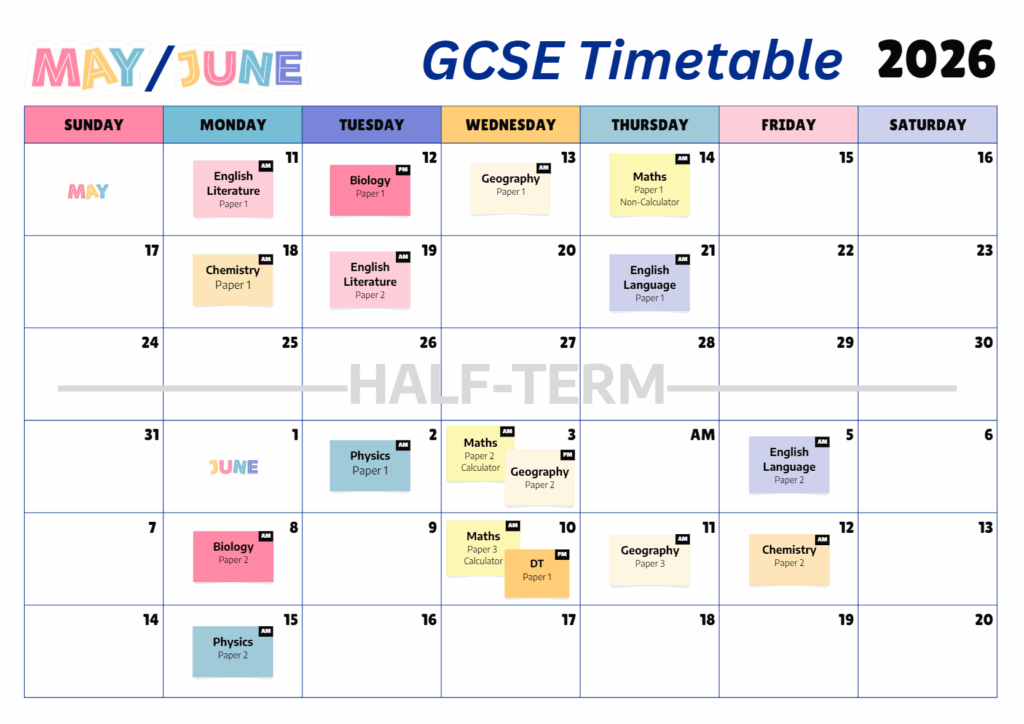
I have put together a simple blank GCSE exam dates 2026 timetable template you can download and fill in with your child’s dates. Print it, stick it up, colour-code it – whatever works best for your family.
Download the blank GCSE exam timetable here
How to plan revision around the GCSE exam timetable
Once you know the GCSE exam dates for 2026, it becomes much easier to plan revision realistically.
Looking at the timetable often shows where certain subjects are grouped together. For example, science exams are often scheduled quite close to each other, while subjects like English and maths may be spaced out across several weeks.
This is where creating a simple revision timetable can really help. Rather than trying to revise everything at once, students can focus on the subjects that are coming up first while still keeping the later exams ticking over.
Even something as simple as mapping revision topics against the exam dates can make the whole process feel far more manageable.
If you’re trying to figure out how to structure revision at home, you might also find my guide to GCSE revision and surviving exam season helpful.
When is GCSE results day 2026?
While exam season finishes in June, results don’t arrive until later in the summer.
GCSE results day is expected to fall on Thursday 20 August 2026, following the usual schedule of results being released on the third Thursday in August. If you’re wondering what actually happens on the day itself, I’ve written a guide on GCSE results day and what parents can expect. And if your teen is already thinking about celebrating afterwards, I’ve also put together a guide to GCSE results day food deals and restaurant offers.
For Year 11 students, this is the day they find out their final grades and confirm their next steps – whether that’s sixth form, college or apprenticeships.
The reality for parents
GCSEs 2026 might sound like they’re ages away, but once Year 11 gets going, it will fly past. Having the dates written down doesn’t magically make it all less stressful, but it does help everyone feel a bit more in control. For us, sticking E’s chart up on the fridge means no excuses for “forgetting” what’s coming next, and I can already see it stopping a few arguments before they start.
Revision timetables, though? That’s a whole other battle…
What is the GCSE contingency day in 2026?
Each year, the exam boards include a GCSE contingency day at the end of the exam season.
This is a reserved day used if a national disruption means an exam has to be moved. For example, this could happen due to severe weather, major transport disruption, or another event that prevents exams from taking place as planned.
In 2026, the GCSE contingency day is expected to fall towards the end of June, after the main exam timetable has finished.
Schools normally ask students to keep this day free, even if their final exam appears to be earlier, just in case an exam needs to be rescheduled.
For most students, this date isn’t used, but it’s still important not to book holidays or travel that would clash with the contingency date.
Related GCSE Guides